Louisiana sits in one of the most humid parts of the United States, with average relative humidity in major cities such as Baton Rouge, Lafayette, and New Orleans often hovering in the mid-70% range through much of the year.
That moisture fuels mold, algae, and mildew on roofs, siding, concrete, and commercial façades, which slowly erodes curb appeal and can shorten the life of exterior materials if neglect continues.
At the same time, the right mix of soft washing, pressure washing, and eco-friendly cleaning methods allows property owners to manage Louisiana humidity and exterior cleaning safely and effectively without harming stucco, brick, wood, or shingles.
This guide explains how Louisiana’s humid climate affects a home’s exterior and commercial buildings, what happens to common exterior surfaces over time, and how soft washing compares to pressure washing.
Additionally, this guide also explains how often residential exterior cleaning and commercial washing services make sense in real Baton Rouge, LA, and Lafayette conditions. It also pulls in public-health data on mold exposure, so you can treat exterior cleaning services as part of a long-term maintenance plan rather than a cosmetic extra.
How Louisiana Humidity and Exterior Cleaning Interact Day to Day
Louisiana has a classic humid subtropical climate: hot, long summers, mild winters, and year-round precipitation. In practice, that means exterior surfaces seldom get a long, dry break. Baton Rouge’s humidity averages roughly the mid-74% range, and Lafayette and New Orleans show very similar numbers, particularly in the warm season.
That constant moisture acts like a life support system for mold and algae on vinyl, stucco, brick, and asphalt shingles. Industry guides aimed at Louisiana property owners now openly state that Louisiana’s humid climate accelerates biological growth on buildings, especially in Baton Rouge and other Gulf cities. It is the background condition behind almost every “exterior cleaning house” problem in the state.
To put the environment in context, the table below summarizes humidity patterns in a few key metros that drive a lot of searches for “exterior house cleaning services near me” and “commercial pressure washing companies near me.”
| City | Typical Warm-Season Relative Humidity (avg) | Climate Notes Relevant to Exterior Cleaning |
| Baton Rouge | Around 74% in late summer | Long muggy season from mid-April to late October; frequent thunderstorms keep exterior surfaces damp. |
| New Orleans | Around 76% annual average, among the most humid US cities | Warm, wet, and windy coastal climate; salt and humidity combine to stress paint, metals, and sealants. |
| Lafayette | Summer humidity is often 74–76% | Very humid from May through September; high dew points keep surfaces wet overnight. |
When you put Louisiana humidity and exterior cleaning together, you get a simple equation: moisture plus organic dust plus shade equals mold and algae. Exterior cleaning service providers in Baton Rouge and Lafayette are not exaggerating when they say cleanings need to happen more often here than in drier states.
What Louisiana’s Humid Climate Does to Your Home’s Exterior
Mold, Algae, and Health Considerations
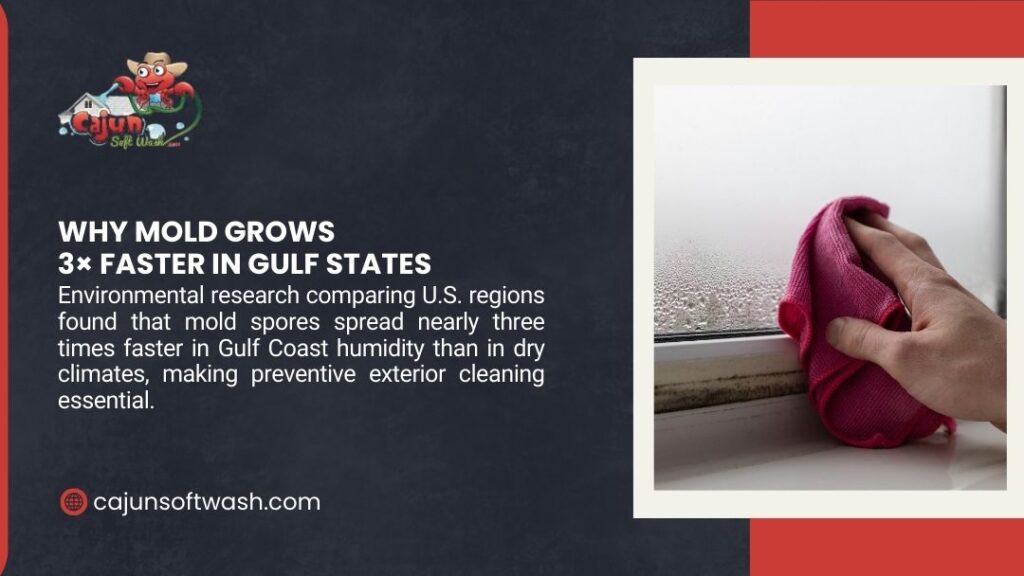
On a home’s exterior, mold and algae usually start as faint green or black streaks. Left alone in Baton Rouge’s humidity, that film thickens and spreads. Mold growth has been linked by major health bodies, including the CDC and WHO-aligned research groups, to increased risks of asthma, wheeze, cough, and other respiratory symptoms for building occupants when it gains a foothold indoors.
Exterior mold does not automatically mean indoor contamination, but untreated damp walls and roof systems raise the odds that moisture issues extend behind cladding and into framing, where spores can migrate inward. Public-health guidance is blunt: mold thrives in damp environments, and the core prevention strategy is simple moisture control and regular removal of visible growth. Louisiana’s humid climate makes that harder, but not impossible, with well-planned house washing and exterior cleaning services.
Roofs in Baton Rouge’s Humidity
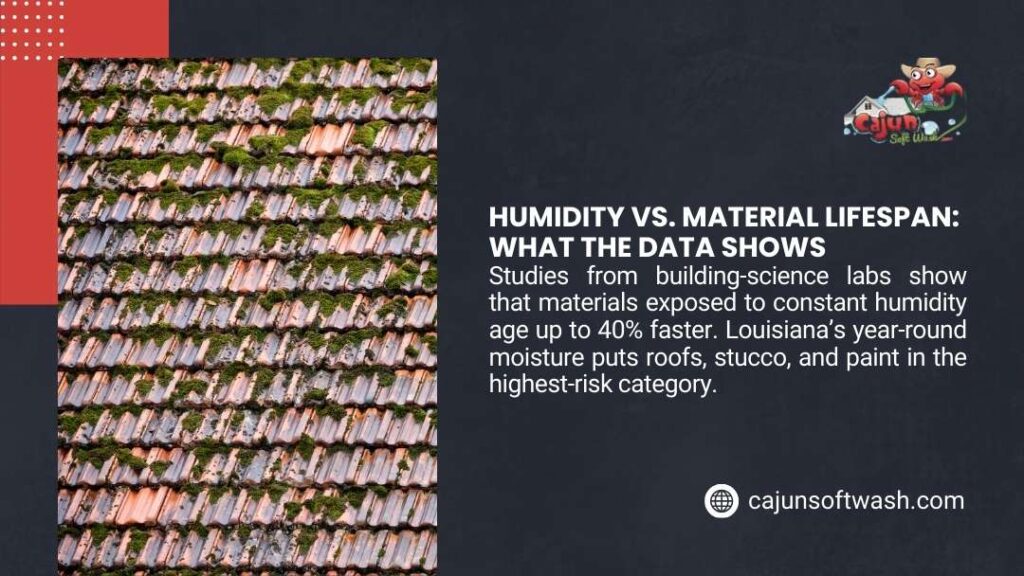
Asphalt shingles and other roofing materials in Louisiana sit in warm, wet air for most of the year. That climate favors blue-green algae (often seen as black streaks), lichen, and sometimes moss. That constant humidity helps all of it spread faster, which is why soft-washing has become the go-to way to clean roofs without stripping off the shingle granules.
A roof that remains stained and damp will not only look older than it is; it can also hold more moisture, which raises the risk of premature aging. Data from building-science and moisture-control guidance documents show that water-logged materials decay faster and, if not dried promptly, can require full replacement.
That is why roof cleaning professionals who focus on soft washing in Louisiana tend to recommend periodic treatments even when leaks have not appeared.
Stucco, Siding, and Painted Surfaces
Stucco and painted siding trap dust on their slightly textured surfaces. In Louisiana’s humid climate, that dust becomes food for mold and algae. Exterior home cleaning services that work around Baton Rouge’s humidity often warn that high-pressure washing, safely used on concrete, can gouge stucco or drive water behind siding.
Soft washing uses low pressure paired with the right cleaning solution to clear away algae and other buildup without beating up the stucco. Most of the time, it’s as simple as using a mild detergent, taking your time, and knowing when a job’s small enough to DIY or big enough to hand off to a pro. The key is avoiding anything too harsh that could push water into tiny cracks or damage the finish.
Concrete, Driveways, and High-Traffic Areas
Driveways, sidewalks, and parking lots in Louisiana stay wet longer than in much of the country, especially in shaded or high-traffic areas that hold fine grit. When that grit mixes with organic matter, it turns into a slip-prone film that collects mold and algae. Suppliers and service companies in Louisiana now explicitly frame powerwash cleaning services as a way to prevent mold and mildew buildup on hard surfaces in a humid climate, not just as a cosmetic service.
Commercial Storefronts and Building Envelopes
Commercial buildings in Baton Rouge and other Louisiana metros fight the same humidity but also deal with more exhaust, foot traffic, and parking lot grime. All that buildup on façades and walkways doesn’t just look bad; it slowly eats away at sealants and coatings. High-rises feel it too, especially around signage and areas where water drips or condensation collects, which makes them magnets for mold and algae.
The table below gives a snapshot of common Louisiana exterior issues and how they tie back to humidity.
| Exterior Element | Main Humidity-Driven Problem | Typical Growth Timeline in Louisiana | Recommended Cleaning Response |
| Asphalt shingle roof | Black algae streaks, lichen, moss | Visible within 2–3 years in shade | Soft washing with a roof-safe solution by a roof cleaning professional. |
| Stucco or painted siding | Green or black biofilm, staining, hairline cracks | Seasonally, within 1–2 years on north or shaded walls | Low-pressure soft washing; avoid high PSI; repair cracks after cleaning. |
| Wood decks and fences | Mildew, algae, and rot in shaded boards | Often noticeable after one wet season | Gentle washing plus sealing; avoid harsh pressure that frays fibers. |
| Concrete walks/driveways | Slippery algae film, black spots | After each warm, wet stretch | Professional pressure washing or surface cleaner with suitable detergents. |
| Commercial façades | Streaks, oxidation, and mold near water paths | Year-round in Baton Rouge’s humidity | Scheduled commercial pressure washing or soft washing, often annually. |
Why Louisiana Humidity and Exterior Cleaning Cannot Be Separated
It describes a long-term maintenance relationship between the climate and every exterior surface on a building. In a drier state, you might treat house washing or outside cleaning services as occasional cosmetic upgrades. In Louisiana’s humid climate, exterior cleaning services function closer to basic preventive maintenance.
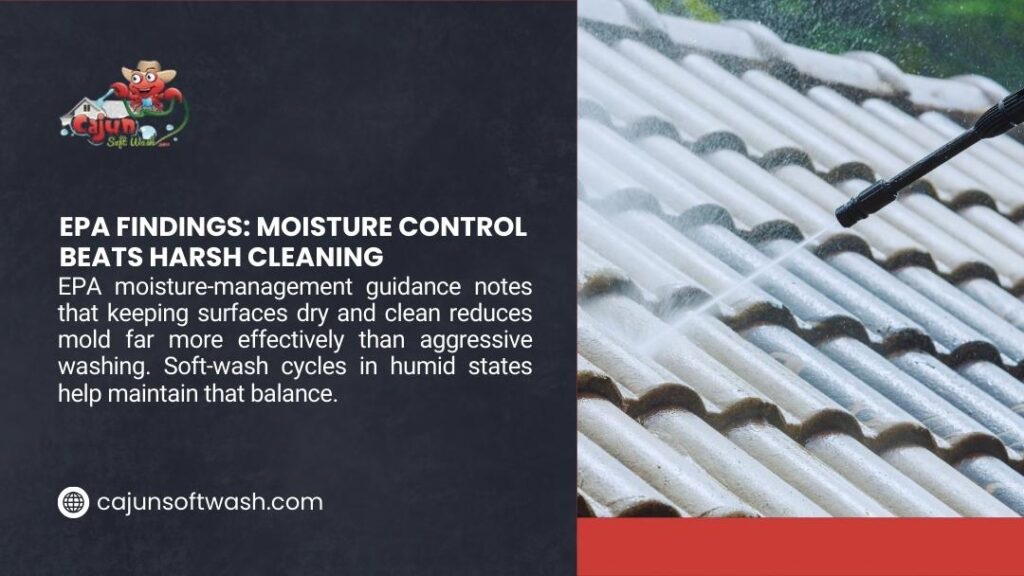
Humidity keeps surfaces damp for long periods. Moisture-control documents from the EPA and other agencies stress that keeping surfaces dry is the key to preventing mold growth and material degradation, and that wet materials should be dried within about 48 hours after a wetting event to avoid mold.
Louisiana’s pattern of frequent showers plus slow drying makes that target difficult; regular exterior home cleaning service visits help reset the exterior back to a clean, less hospitable state for mold and algae.
Homeowners in Baton Rouge’s humidity often notice that sections of a home’s exterior facing north, shaded by trees, or near sprinkler overspray show faster staining. Residential exterior cleaning or professional exterior house cleaning that focuses on these trouble zones can prevent more expensive repairs to paint, cladding, or structural members later.
Soft Washing, Pressure Washing, and Washing Safely in Humid Louisiana
Exterior cleaning in a climate as wet as Louisiana’s comes down to choosing the right cleaning methods for each surface. Most exterior cleaning companies in the state now pair pressure washing with soft washing rather than treating them as either-or options.
Soft washing relies on low pressure and a carefully mixed cleaning solution to kill mold and algae on roofs, stucco, and delicate siding. Proper soft washing removes the growth rather than just blasting off the surface layer. Soft washing protects roof warranties and prevents etching paint, mortar, or synthetic trim.
Pressure washing, by contrast, uses higher pressure to remove dirt, gum, hardened buildup, and heavy grime on concrete, brick pavers, and some metal. In high-traffic parking lots and loading zones, it remains the most efficient way to clean. The key is washing safely: using the right PSI, nozzle, and distance for the material.
The table below compares soft washing and pressure washing in the context of Louisiana humidity and exterior cleaning.
| Method | Best For in Louisiana’s Humid Climate | Risk if Misused in Baton Rouge’s Humidity | Typical Use Case in Louisiana |
| Soft washing | Roofs, stucco, painted siding, vinyl, composite trim | If applied with the wrong mix, it may leave residue or an incomplete kill of mold and algae. | Roof cleaning, house washing, fence and deck brightening on softer woods. |
| Pressure washing | Concrete, brick pavers, curbs, parking decks | Excess pressure can scar concrete, open joints, or force water into cracks; harmful to stucco or shingles. | Driveway washing, parking lot cleaning, loading-dock cleanup, and some masonry. |
| Hybrid approaches | Mixed-material façades and complexes | Need experienced exterior cleaning specialists who understand each surface. | Commercial plazas with brick walks, stucco walls, and metal railings at once. |
For homeowners who want exterior house cleaning services without risking damage, working with a contractor that emphasizes soft washing for vulnerable surfaces and uses pressure washing only where appropriate is the safest path.
Residential Exterior Cleaning Strategies in Louisiana’s Humid Climate
For a lot of homeowners, the search for an exterior house cleaning service near me doesn’t happen until the green streaks or black patches are already hard to ignore. In Louisiana, waiting that long means the growth has already taken advantage of Baton Rouge’s humidity or Lafayette’s muggy summers.
Local pressure-washing and house washing generally connect on an annual service schedule for homes in very humid areas, with more frequent cleanings in shaded or tree-covered lots.
A residential power washing services plan in Louisiana usually includes periodic house washing, driveway cleaning, and selective roof cleaning based on age and condition. For some homeowners, exterior home cleaning services also extend to decks, fences, pool decks, and even solar panels, especially as more roofs in Louisiana carry solar installations that still depend on clean glass to perform well.
Many soft-wash companies now share tips for keeping solar panels clean in wet, humid climates, making it easier for owners to fold panel maintenance into their regular cleaning routine instead of treating it like a separate chore.
A property owner in Baton Rouge, Denham Springs, or Prairieville who wants exterior cleaning services that match Louisiana’s humid climate can also look for providers who specialize in residential exterior cleaning built around soft wash chemistry, careful plant protection, and low-pressure rinses.
Suppose a pressure-washing company takes the time to explain how they clean stucco, vinyl, concrete, and roofing in Louisiana’s humid climate. In that case, it’s a strong sign they understand the local conditions and aren’t just offering a generic wash. That kind of detail helps you spot a contractor who actually knows how to protect your home’s exterior.
Commercial Exterior Cleaning in High-Traffic Louisiana Locations
Commercial buildings work harder than houses. High traffic means more dirt tracked onto walks and entries, more tire marks in lots, more grease near dumpsters, and more airborne contaminants on glass and upper façades. In Baton Rouge’s heavy humidity, regular commercial pressure washing isn’t just about keeping a property looking sharp, it also helps cut down on slip hazards and protects building materials from wearing out too soon.
When you search for a commercial pressure washing company in Baton Rouge or Lafayette, you’ll usually find teams that handle everything from building and walkway cleaning to dumpster pads, drive-through lanes, restaurant patios, and bank canopies. Because of Louisiana’s humidity and the steady flow of customers these places get, most companies offer flexible night or off-hours cleaning so businesses don’t have to pause operations.
Some Louisiana exterior cleaning specialists now highlight parking lot soft washing as a complementary service. Soft washing in this context means using chemistry and moderate pressure to break down organic film while still using enough water flow to clean high-traffic asphalt and concrete.
Property managers who want to stay ahead of the grime can look into how soft washing works for parking lots. The basic idea is that gentle, consistent cleanings do a better job of protecting striping, sealers, and joints than the occasional harsh blast, especially in Louisiana’s humid climate.
Beyond basic washing, commercial exterior cleaning often includes brick cleaning and stucco cleaning for retail façades, each of which reacts differently to pressure and moisture. These days, guidance on cleaning commercial exteriors in humid climates leans heavily toward gentler methods, especially for stucco and other porous masonry.
The goal is to clean the surface without forcing water deeper into materials that already stay damp longer than they would in a drier environment.
Timing Exterior Cleaning Around Louisiana’s Seasons
In Louisiana, most folks time their bigger pressure-washing projects for spring or fall, when the weather’s comfortable and surfaces dry a little faster. Even winter can be a workable season in south Louisiana, since temperatures rarely stay below freezing long enough for water to ice over.
The state’s climate, hot, humid summers, mild winters, and steady rainfall year-round, shapes how people plan their cleaning schedule. Instead of doing everything once a year, many property owners break it up: roofs and siding in the spring, concrete and high-traffic areas in early fall, and quick touch-ups in those shady, tree-covered spots that tend to stay damp.
| Property Type | Typical Exterior Surfaces | Suggested Cleaning Frequency in Louisiana’s Humidity | Notes for Baton Rouge’s Humidity and Lafayette Pressure Washing Needs |
| Single-family home (suburban) | Shingle roof, vinyl or brick, concrete drive | House washing every 12–18 months; roof soft wash every 3–5 years, depending on shade. | Shaded lots or tree-covered roofs may need shorter roof intervals, especially near Baton Rouge’s river fog zones. |
| Townhome or small multifamily | Mixed siding, shared walks | Exterior home cleaning services every 12 months; shared walks annually. | HOA rules often now treat washing as mandatory due to algae on shared walls. |
| Restaurant or retail on a busy road | Stucco or brick, canopy, parking lot | Building wash every 6–12 months; parking lot washing services 2–4 times per year. | Grease and high traffic mix with humidity to create slick films on walks. |
| Office building with structured parking | Glass, concrete, painted steel | Façade cleaning every 12–24 months; parking structure pressure washing annually. | New Orleans and Baton Rouge CBD towers see more particulate matter that adheres to damp glass. |
Long-Term Protection: Treat Humidity as a Constant, Not a Surprise
Louisiana’s humidity isn’t going anywhere, and waiting for green streaks or black patches to take over your exterior just means more damage and higher costs later. The smartest move, whether you own a home or manage a commercial property, is to treat exterior cleaning as routine maintenance, not a once-in-a-while fix.
With the right mix of soft washing, pressure washing, and a crew that actually understands our climate, you can stay ahead of mold, algae, and grime instead of constantly fighting them.
If you’re ready to protect your property and keep it looking sharp year-round, Cajun Soft Wash has your back. Get in touch and lock in a cleaning plan that actually works in Louisiana’s humidity.