Louisiana never stays dry for long. The Gulf pushes moisture into the air, summer afternoons end in thunderstorms, and winter still traps humidity against the building envelope. That climate turns asphalt shingles into a comfortable habitat for algae colonies, especially the dark bacterial strain known as Gloeocapsa magma.
When a roof never dries, it invites discoloration, surface deterioration, moss invasion, and granule loss. This article maps the science behind algae growth in humid climate conditions, explains why Louisiana homes suffer more noticeable damage, and outlines safe removal options that avoid shingle destruction or warranty issues.
A homeowner who understands moisture retention, limestone filler inside asphalt shingles, and ventilation will avoid premature roof replacement. Anyone who ignores recurring dark stains risks higher attic temperatures, lost reflective performance, and a steady attack on shingle life.
Why Algae Growth in Humid Climates Intensifies in Louisiana
Louisiana’s humid subtropical climate keeps moisture levels high for most of the year, creating slow evaporation and persistent dampness on exterior surfaces, especially roofs. Warm, wet air supports cyanobacteria development, and a roof coated with limestone filler provides a nutrient source.
Gloeocapsa magma, a type of cyanobacteria commonly found on asphalt roofs, produces the black streaks seen on shingles. It thrives in moist conditions and is reinforced by the limestone filler in asphalt shingle materials, which provides a nutrient source as the colonies multiply. Rather than wind erosion, the material breakdown comes from repeated wet-dry cycling in a region that rarely offers a full dry cycle.
Those conditions do not appear in Nevada or central Arizona, where the roof surface heats and dries rapidly. Gulf moisture creates a completely separate maintenance reality. Neighborhoods packed with live oaks add shade across north-facing slopes, so the shingles never reach a drying temperature. Moisture under trailing limbs creates darker bands of algae across the roof field, and moss eventually takes root in granule loss zones.
A Louisiana Micro-Climate on Each Roof Surface
Roof planes do not age evenly. A south slope above a driveway receives sun for hours and dries almost every night. A north slope above an oak canopy rests in shadow and remains damp. Louisiana’s humidity traps wet air above that shaded pitch, and black streaks creep downhill. Valleys also collect moisture because water flow concentrates in a narrow channel. Any flaw in gutter drainage slows runoff and leaves water against the shingle tabs longer than the manufacturer intended.
Humidity invades siding as well. The State of Louisiana Department of Health links long-term moisture to exterior mold formation and warns that airborne spores thrive when surfaces never dry. That same moisture supports algae along stucco, painted fascia, and concrete flatwork.
Difference Between Algae, Moss, Mold, and Lichen in a Humid Climate
Residents often mislabel the material they notice on the roof. Dark streaks usually indicate algae. A thick green pad indicates moss. A white or gray crusty patch can show early lichen development. Mold tends to remain inside attics and wall cavities because it prefers organic debris, not minerals on shingles. The table below sorts the organisms in a Louisiana climate.
| Organism | Usual Surface Appearance | Effect of Louisiana Humidity | Risk to Roofing Material | Appropriate Treatment |
| Algae (Gloeocapsa magma) | Dark streaks, thin surface smear | Rapid multiplication due to constant moisture | Cosmetic discoloration and loss of reflective value | Low-pressure soft wash with roof-safe solution |
| Moss | Green clumps or pads | Spreads across shaded slopes with long wet cycles | Traps moisture, accelerates granule loss | Controlled chemical treatment with careful rinse |
| Lichen | Crusty plate adhered to the shingle surface | Anchors where shingles already decayed | Mechanical adhesion and surface lift | Requires specialist removal and slow treatment |
| Mold | Usually interior cavity issue | Exterior humidity fuels interior moisture | Structural and health hazard | Interior moisture control and remediation |
Material Vulnerability in Louisiana’s Humid Climate
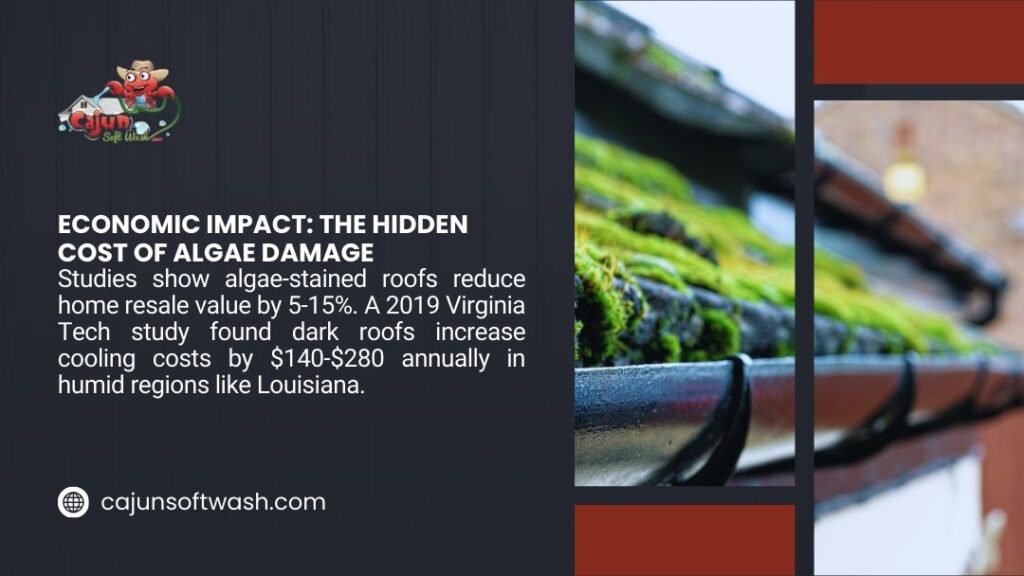
Asphalt shingles use granules for UV resistance and limestone filler to stabilize asphalt. Algae use that limestone content as a food source, which explains why homes near the coast show dark tracks within a decade. Moss does more direct damage. It locks moisture under the tabs, softens asphalt, and weakens adhesion between shingle layers. High attic humidity compounds the problem because trapped hot air pushes vapor upward.
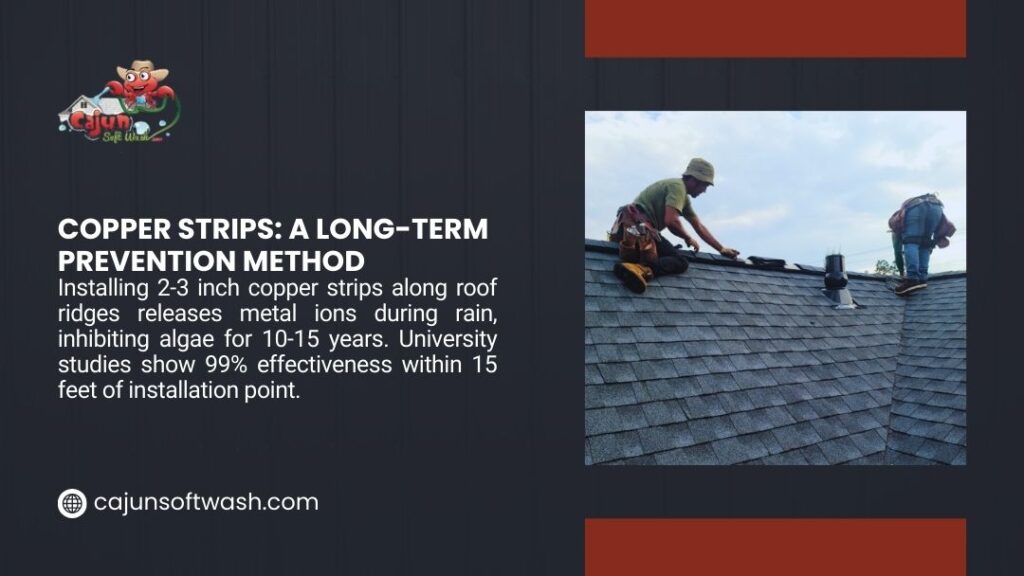
Metal roofing does not support algae in the same way, but moisture still promotes oxidation at penetrations and fastener lines. Clay tile resists biological growth, although moss can root inside joints where debris collects. Algae-resistant shingles incorporate copper or zinc particulate inside granules to slow growth.
The table below compares material risk.
| Roofing Material | Algae Susceptibility in High Humidity | Main Visible Symptom | Effect on Service Life | Cleaning Approach |
| Asphalt shingles | High due to limestone filler | Black streaks advancing down slope | Lower reflectance, moisture retention | Soft wash with roof-approved mix |
| Metal roof | Low on surface, moderate at edges | Spots at fasteners, runoff streaks | Minor unless corrosion begins | Mild detergent wash |
| Clay or concrete tile | Moderate in shaded areas | Green haze near overlaps | Rare structural reduction | Professional rinse and solution |
| Algae-resistant shingles | Low | Rare streaking | Stable over time | Routine maintenance |
How Moisture Alters Roof Performance in Louisiana?
Dark streaks do more than alter curb appeal. The National Renewable Energy Laboratory tracks how darkened surfaces raise rooftop temperatures and reduce solar reflectance. When algae darkens a roof field, attic heat increases. A Baton Rouge home without adequate ventilation then faces higher interior loads and can force a cooling system into constant operation.
Moss advances the process. Once clumps sit within the shingle field, they hold water overnight. The roofing system never completes a dry cycle. Granules loosen as the substrate swells. A homeowner then sees weeping asphalt, soft corners, and separated laminate layers. When a roofer inspects such a surface, insurance rarely treats the issue as a storm loss. It falls under maintenance neglect.
Safe Removal of Algae on Roofs in a Humid Climate
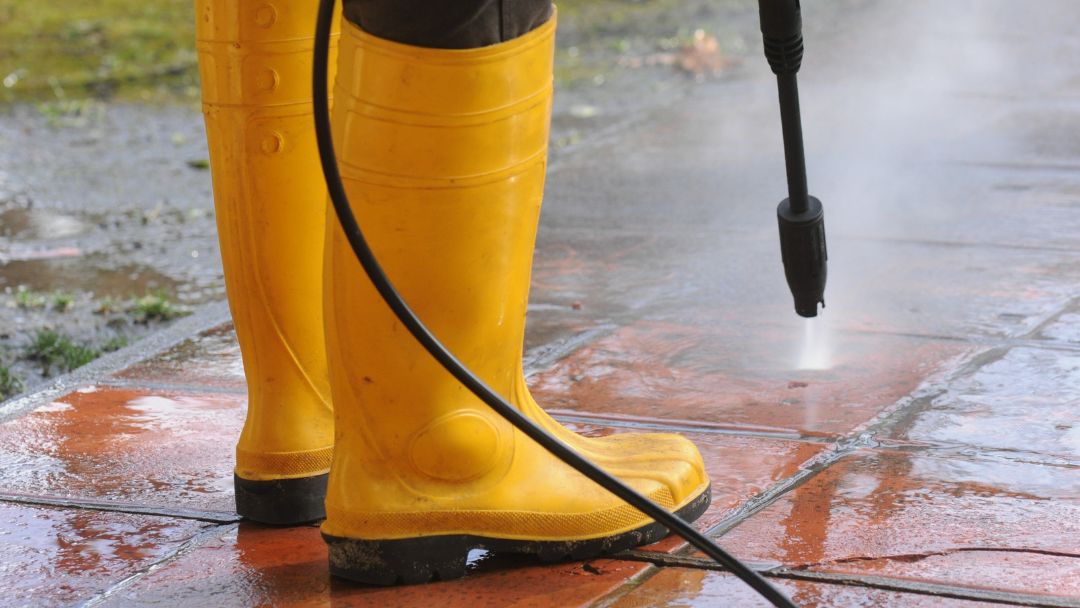
High-pressure washers remove more life expectancy from shingles than algae. Industry guidance on asphalt shingles explains that using high-pressure washing on roof stains can strip protective granules and may even jeopardize warranty coverage, which is why gentle cleaning methods are recommended.
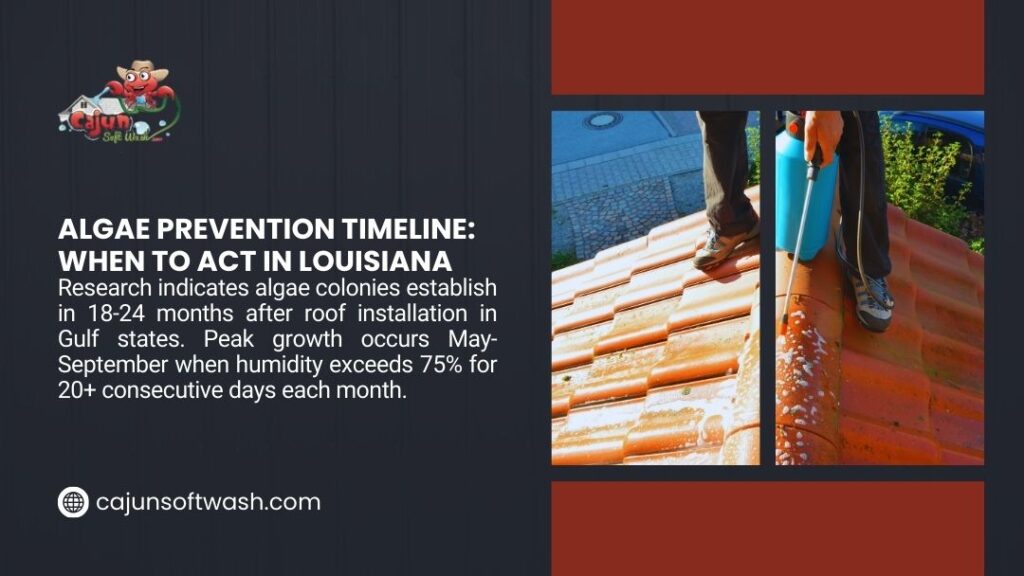
The safer method replaces force with controlled chemistry. A professional roof cleaning service applies a roof-grade sodium hypochlorite dilution and surfactant through controlled low-pressure. The solution remains on the roof long enough to break apart cyanobacteria cells. The rinse phase avoids water intrusion. Plant and property protection guard leaves, metal, and runoff.
Soft washing differs from a homeowner with a hose and a gallon of bleach. Dwell time, runoff control, dilution accuracy, and equipment safety keep the assembly intact. The humid climate complicates this because surfaces stay wet for hours. A trained technician watches runoff edges and avoids streaked rinse patterns.
DIY Attempts Vs Professional Removal in Louisiana Moisture
A homeowner who tries bleach in summer humidity risks uneven bleaching, burned vegetation, and ladder falls on a slick surface. An amateur treatment can also leave patches of live algae in shaded roof valleys. Moss requires a longer kill cycle. Lichen refuses to detach until the softened substrate releases, which means a careless homeowner may pry off granules or entire tabs.
Consider the comparison below.
| Method | Cost Reality | Risk in Louisiana Humidity | Likelihood of Full Removal | Impact on Roof Warranty |
| DIY bleach mix | Low at purchase | Patchy results and plant damage | Inconsistent on moss or lichen | Possible void due to chemical misuse |
| Pressure washing | Medium | High due to granule loss and water intrusion | Rapid removal with roof damage | Often voids the warranty |
| Soft washing by trained crew | Moderate | Controlled method with runoff protection | High success with algae and moss | Maintains warranty conditions |
A Louisiana roof rarely dries enough for aggressive tactics. Soft washing respects the limits of the material.
Why Shade, Trees, and Ventilation Matter in the Gulf Region
Every shingle must dry at night. A roof under a thick oak branch receives little daylight. Leaves fall into valleys and keep water against raised edges. A simple trimming schedule eliminates that trapped moisture. Ventilation completes the equation. If an attic holds hot, moist air, vapor presses into the roof deck. That vapor sits behind the shingles and adds to the algae conditions. Proper attic ventilation helps remove excess heat and moisture from the attic space, which can reduce temperature extremes and limit moisture buildup that contributes to mold and structural issues.
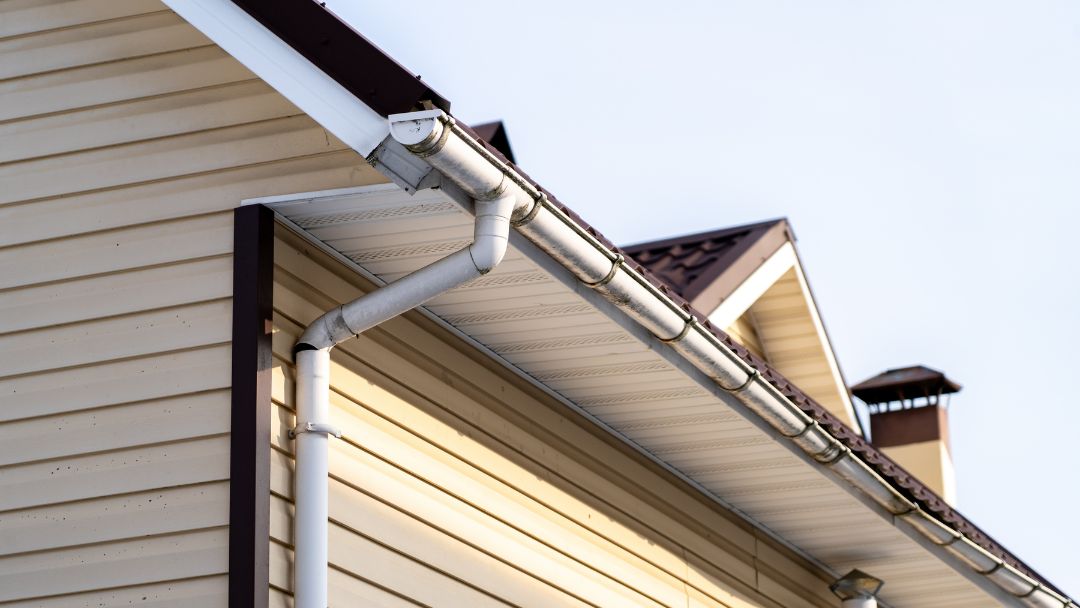
Routine gutter care matters as well. If downspouts overflow, water flows back under shingle courses. A small leak in a valley flashing joint provides a cradle for moss.
A Broader View of Exterior Surfaces in a Humid Climate
Roofs are not the only victims. Stucco walls absorb airborne moisture. Dark patches appear along the north elevation because wet air never burns away. Acrylic finishes support organic staining. If you want a quick walk-through on keeping exterior walls clean, Cajun Softwash has a simple breakdown of its soft-washing approach.
Concrete also attracts microbial buildup. Pool patios and walkways show green haze where water settles near the coping. Those areas require controlled surface treatment rather than extreme pressure.
When Cleaning Stops and Replacement Starts
A roof reaches the end of its service period when algae coincides with structural decay. A contractor looks for lifted laminate edges, exposed fiberglass mat, missing granules across large patches, or daylight at fastener penetrations.
When those conditions appear, cleaning no longer extends the useful life. Replacement or partial re-decking solves the problem. Louisiana humidity accelerates aging once moisture sits beneath the shingle course.
Questions Louisiana Homeowners Ask About Algae Growth in Humid Climates
Algae on asphalt does not always signal total failure. It does show that moisture control slipped. Bleach can kill algae but may break warranties and burn foliage. Professional soft washing provides the safest correction when humidity complicates surface drying. Louisiana homes close to tree lines must evaluate ventilation, shade, and gutter performance more often than homes in dry regions.
The dominant algae species on roofs across the Gulf remains Gloeocapsa magma. Once established, it spreads through airborne transfer. Homeowners who trim branches, improve ventilation, and schedule routine service prevent recurrence. Annual or semi-annual checks help because the region does not supply long dormant periods.
Protecting a Louisiana Roof Against Humid-Driven Algae Growth
Algae growth in humid climate zones will always concentrate in Louisiana due to a combination of Gulf air, shaded slopes, rainfall frequency, and limestone content in modern asphalt shingles. That does not mean a homeowner must tolerate black streaks or granule loss. Sound ventilation, controlled shade, drainage maintenance, and professional soft washing curb microbial growth without stripping the roof. A homeowner who wants predictable results should speak with a local company that treats algae through controlled chemistry rather than pressure. A service request through the Cajun Softwash allows an evaluation of roof age, slope exposures, and moisture history. That first step matters because a humid climate will not ease. The roof must adapt through proper care, not force.