Black streaks on gutters look harmless at first glance, yet they rarely disappear after a normal wash. Many homeowners scrub, rinse, repeat… and the stains creep back within months. The reason is simple: most people treat the symptom instead of the source.
This guide explains why black streaks form on gutters, how to clean them properly, and how to break the cycle so the stains don’t return next season.
Why Black Streaks on Gutters Don’t Wash Off
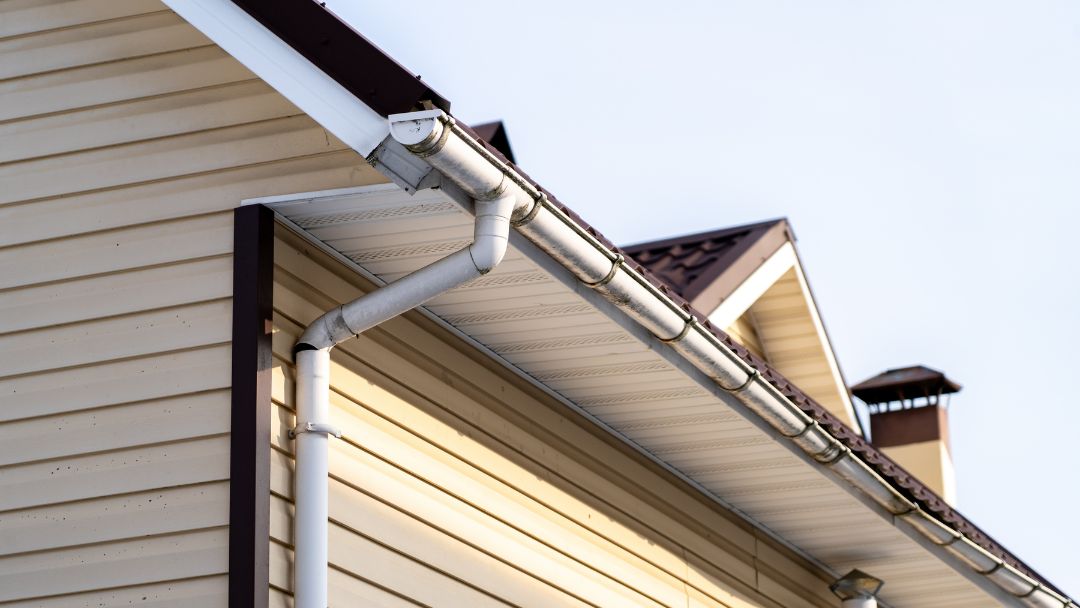
Black streaks on gutters are commonly called tiger stripes. They aren’t ordinary dirt. They’re a bonded residue formed when organic roof runoff attaches to the outer surface of an aluminum gutter.
Rainwater carries microscopic particles from shingles. Those particles include limestone filler, asphalt oils, and airborne pollutants. Once they meet the painted surface of the gutter, they cling to the finish due to electrostatic charge differences between the coating and the minerals.
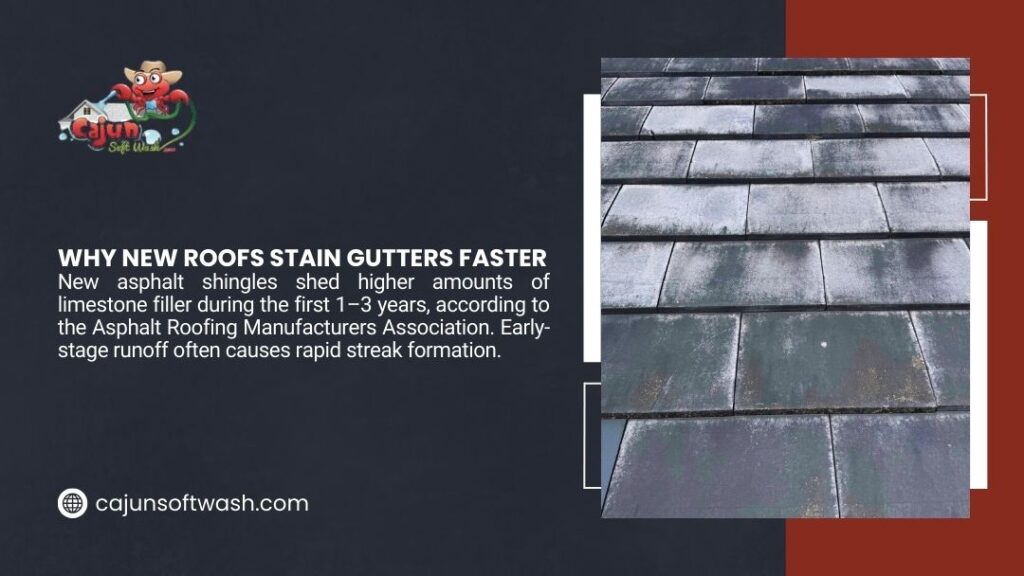
According to the Asphalt Roofing Manufacturers Association, asphalt shingles shed mineral filler over time as part of natural weathering, especially during heavy rainfall cycles. Those minerals become the primary ingredient in gutter staining.
The result is a vertical stain pattern that follows the water path rather than spreading evenly across the surface. That pattern alone tells you the stain isn’t soil, it’s a chemical attachment.
This also explains why rinsing alone doesn’t remove black streaks on gutters. Water created the bond, so water can’t break it.
Causes of Black Gutter Streaks
Several factors combine to create streaking. One single cause rarely produces the problem alone. The stains form when minerals, organic growth, and environmental pollutants meet moisture and repeated water flow.
Before looking at the breakdown below, it’s helpful to remember that the roof always feeds the gutter system. If something exists above, it eventually shows below.
| Cause | What Happens | Why It Darkens |
| Asphalt shingle filler | Limestone particles wash off the roof | Bonds to gutter coating |
| Algae fragments | Biofilm travels in runoff | Traps airborne dirt |
| Air pollution | Carbon particles attach to moisture | Creates black coloration |
| Paint electrostatic charge | Opposite charges attract residue | Prevents rinsing away |
| Repeated drip lines | Same water path each storm | Builds layered staining |
Once the first layer forms, it acts like adhesive for the next one. Over time, the streak thickens, which is why older homes show sharper lines than newer ones.
Why gutters develop vertical staining patterns
The streak shape isn’t random. Each line marks a consistent drainage path from the roof edge. A gutter receives thousands of micro-flows during rain, but only certain sections carry concentrated runoff.
Here’s what happens:
- Roof runoff gathers in tiny channels along the shingle edge.
- That water concentrates contaminants.
- The water drips over the lip at repeating points.
- Gravity pulls residue down the same track.
Instead of spreading across the gutter face, the residue travels in narrow bands. Over time, those lines darken. That’s why dirty gutters look striped rather than uniformly dull.
Homes in humid climates experience heavier streak formation because biological material grows faster on roofs. And that’s why it matters, the gutter is showing you what’s happening on the roof above it.
Are tiger stripes bacteria, mold, or oxidation
Before choosing a cleaner, you need to identify what the stain actually is. Many homeowners mistake it for mold because of the dark color.
| Characteristic | Roof Runoff Staining | Mold Growth | Paint Oxidation |
| Appearance | Vertical black lines | Spotty dark patches | Chalky fading |
| Location | Only under the drip line | Anywhere moisture sits | Entire surface |
| Cleaning difficulty | Moderate | Easy with biocide | Permanent damage |
| Returns after cleaning | If roof untreated | If moisture persists | Always |
| True cause | Mineral + organic bond | Living organism | Paint breakdown |
Black streaks on gutters are not mold colonies. They contain organic material, but the main binder is petroleum-based asphalt residue mixed with environmental pollution. That chemical combination sticks to the paint layer.
How roof organisms travel into the gutter system
The roof functions like a biological ecosystem. Algae grows on shingles, pollen settles, and dust accumulates. During rain, water acts as a transport system.
As water moves across shingles, it carries tiny fragments of organic growth with it. Those fragments mix with asphalt oils and minerals. By the time runoff reaches the gutter lip, it has turned into a suspension of contaminants.
Each storm adds another microscopic layer. The gutter never produces the stain; it only collects evidence of what is happening above.
Homes with visible roof discoloration almost always develop black streaks on gutters within the same season because the runoff source remains active.
Why pressure washing makes stains worse
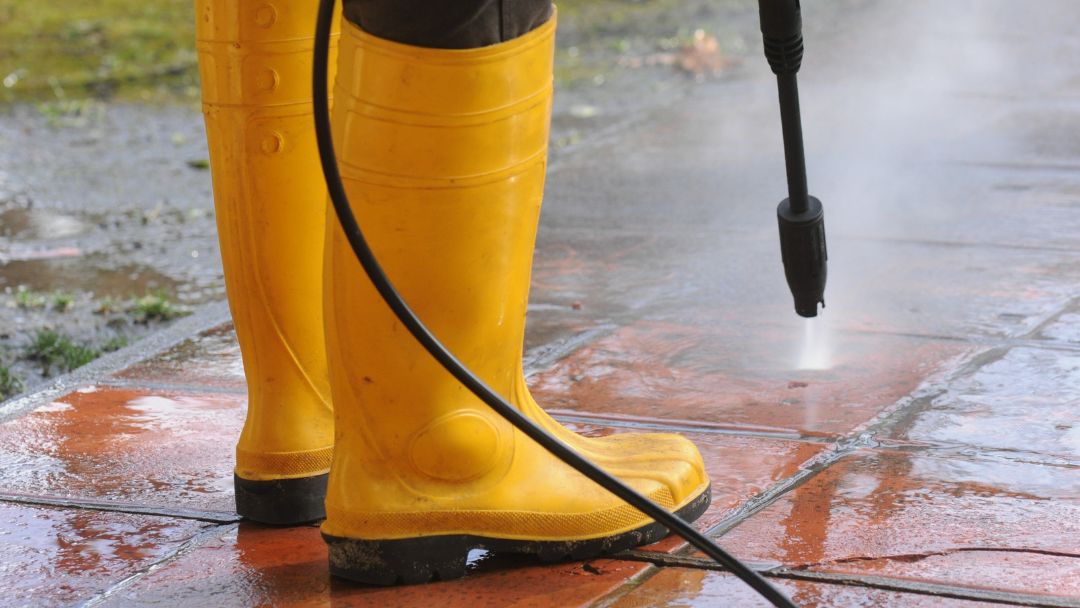
High pressure removes loose dirt but leaves bonded residue behind. Worse, it damages the protective coating on the aluminum.
Once the paint surface becomes rough, future runoff sticks faster and darker. The next rainfall fills microscopic scratches with contamination. Within months, the streaks return, often more pronounced.
Another issue is water intrusion. Forceful spray pushes moisture behind fascia boards and into soffit seams. That moisture can later produce mold staining unrelated to the original streaks.
Gentle chemical cleaning works better because it breaks the bond instead of attacking the surface. Home maintenance studies show that high-pressure washing reduces coating lifespan by exposing the substrate to oxidation. So the quick fix actually shortens the time before the next cleaning.
How to remove black streaks from gutters safely
Chemical process explanation: A proper gutter cleaning solution doesn’t rely on force. It breaks the electrostatic bond between the residue and the paint. Specialized surfactants suspend the particles so they rinse away without abrasion.
Manual cleaning method: Soft brush agitation helps distribute the cleaner evenly across the stain. The goal isn’t scrubbing hard; it’s allowing chemistry time to react.
Low-pressure wash method: Professionals often apply soft washing principles similar to soft washing. Low-pressure rinses the loosened residue without harming coatings.
| Cleaning Method | Damage Risk | Stain Removal | Longevity |
| Pressure washing | High | Partial | Short |
| Household soap | Low | Minimal | Very short |
| Specialized gutter cleaner solution | Very low | Complete | Long |
What to use to clean gutters, depending on the material
Different gutter materials react differently to cleaners. Choosing the wrong chemical can discolor the finish even if it removes the stain.
| Gutter Material | Best Cleaner for Gutters | Notes |
| Painted aluminum | Non-caustic gutter whitening solution | Preserves coating |
| Bare aluminum | Aluminum gutter cleaner | Avoid acids |
| Vinyl | Mild surfactant cleaner | Won’t oxidize |
| Copper | Neutral pH cleaner | Protects patina |
Many homeowners search for what to clean gutters with and grab bleach. Bleach removes organic growth but doesn’t dissolve petroleum residue. That’s why black streaks on gutters remain even after heavy washing.
Professional gutter whitening vs DIY cleaning
Many homeowners start with household cleaners. They often improve the appearance temporarily, but don’t prevent the return of staining.
| Approach | Cost Range | Appearance | Return Rate |
| DIY scrubbing | Low | Inconsistent | Fast |
| Store-bought cleaner | Medium | Good | Medium |
| Residential gutter cleaning service | Higher | Like new | Slowest |
Professional gutter whitening often pairs with broader exterior home cleaning because the same roof runoff affects siding and fascia.
How to prevent black streaks on gutters permanently
Cleaning fixes what exists today. Prevention controls what forms tomorrow. Since the source sits on the roof, stopping contamination upstream reduces gutter staining dramatically.
| Prevention Method | Effectiveness | Why It Works |
| Roof treatment | High | Stops biological growth |
| Annual washing | Moderate | Removes buildup early |
| Trim overhanging branches | Moderate | Reduces organic debris |
| Maintain drainage flow | High | Prevents concentration lines |
Reducing biological activity on the roof greatly decreases the particles that form streaks. Without fresh residue, gutters stay brighter much longer.
When cleaning gutters won’t fix the problem
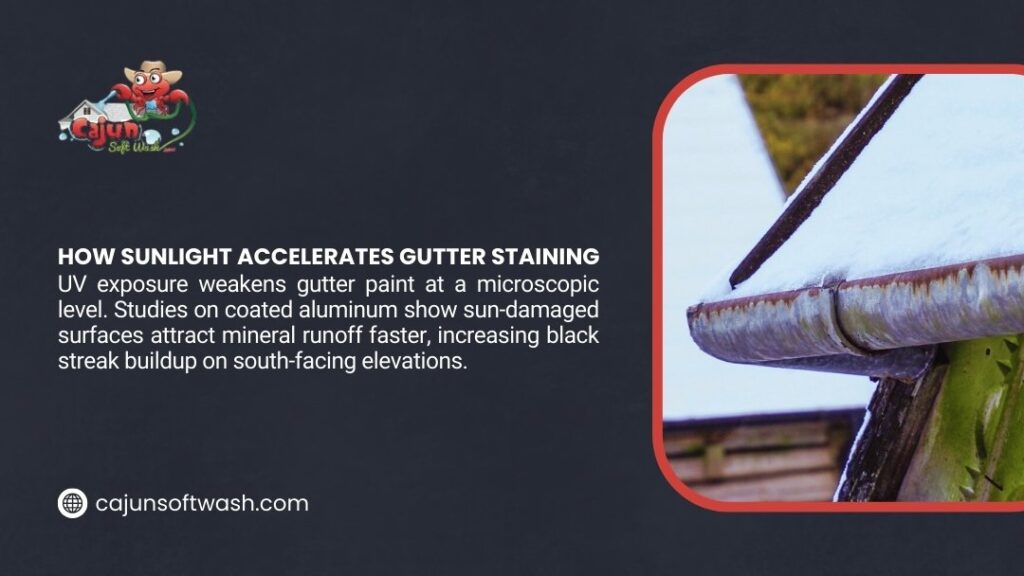
If stains remain gray or faded after cleaning, the paint has oxidized. That condition means the coating deteriorated under years of contamination and sunlight.
No cleaner can restore lost pigment. The only correction is repainting or replacement. Attempting repeated cleaning only thins the coating further and shortens gutter life.
Cost expectations and lifespan results
Cleaning costs vary depending on home size and stain severity, but prevention reduces long-term expense.
| Service Type | Typical Longevity | Relative Cost |
| Basic rinse | Weeks | Lowest |
| Chemical cleaning | 1–2 years | Moderate |
| Cleaning + roof treatment | 2–4 years | Best value |
Treating the source usually doubles the time before stains return, lowering total maintenance spending over time.
Maintenance schedule homeowners should follow
Exterior surfaces stay cleaner when maintenance follows a predictable interval rather than reacting after heavy staining appears.
| Interval | Task | Purpose |
| Every 6 months | Inspect gutters | Catch early buildup |
| Annually | Clean gutters | Prevent bonding |
| Every 2–3 years | Treat roof | Reduce contamination |
| After storms | Check drainage | Avoid concentration lines |
Regular upkeep protects both appearance and material lifespan.

What homeowners should remember?
Black streaks on gutters rarely start on the gutter. They begin on the roof, travel with rainwater, and attach chemically to the metal surface. Cleaning only the visible stain treats the symptom, not the cause.
Address the runoff source, and the streak cycle slows dramatically. Skip that step, and the stripes return season after season.If you want the gutters to stay bright instead of temporarily better, a trained exterior cleaning team can diagnose the source and treat the entire system safely. Reach out to the company to request an inspection and get a clear plan instead of repeating the same cleaning every year.