Most people don’t think about their driveway until something forces them to. A bad first impression from a visitor. Noticing oil stains that have been sitting there longer than you’d like to admit. Or that slow creep of dark algae across the concrete that starts in one corner and quietly spreads everywhere.
Driveway cleaning cost isn’t complicated once you understand what’s actually driving the price. It’s not just square footage, though that matters. Surface type, stain history, local climate, and cleaning method all push the number in different directions.
This guide breaks down real-world pricing from both a homeowner and contractor perspective, explains the factors that quietly inflate quotes, and helps you figure out whether you’re looking at a reasonable number or getting taken for a ride.
Driveway Cleaning Cost: What You’re Actually Looking At
Most homeowners pay about $175 to $320 to clean a standard driveway, though the total driveway cleaning cost can range from $100 to $500 based on size, surface type, and stain severity. That’s a wide spread, and it’s not a dodge. It reflects genuinely different situations.
A clean, lightly soiled concrete driveway in a moderate climate is a different job than a 600-square-foot surface coated in oil residue, algae, and years of embedded grime. Same category of work on paper. Very different job in reality.
For most homeowners, the cost to pressure wash a driveway falls between $0.10 and $0.50 per square foot, depending on what’s going on with the surface. Smaller driveways sometimes carry a minimum service fee; $75 to $100 is common, which can make a small job feel disproportionately expensive per square foot, even when the total is reasonable.
One thing worth flagging early: some contractors quote low to get the job and then add on charges for pre-treatment, stain removal, or sealant application at the end. Ask upfront what the base price covers and what triggers additional charges.
Average Cost to Pressure Wash a Driveway: Per Square Foot Breakdown
Per-square-foot pricing is the most transparent model in the industry. It accounts for labor time, chemical use, and equipment wear more honestly than flat-rate quotes that can mean very different things depending on who’s giving them.
| Type of Cleaning | Cost Per Sq Ft | Typical Total Cost |
| Basic pressure washing | $0.10 – $0.25 | $100 – $250 |
| Heavy stain removal | $0.25 – $0.50 | $250 – $500 |
| Cleaning + sealing | $0.50 – $1.00 | $500 – $1,000 |
A standard two-car driveway runs about 400 to 600 square feet. Using those numbers, most homeowners end up somewhere in the $150 to $300 range for a solid professional clean without extra treatments. Add oil stains, algae growth, or pavers instead of poured concrete, and you’re moving toward the higher end.
One contractor pattern worth knowing: experienced crews often price larger driveways at a slightly lower per-square-foot rate because the efficiency improves on open, rectangular surfaces. If your driveway is shaped like an obstacle course with curves, borders, and landscaping close to the edges, that discount probably won’t apply.
What Affects Driveway Cleaning Cost the Most?
Several variables shape the final price. Some are obvious, others less so.
Driveway size and layout: This is the baseline. More square footage means more time and more chemical solution. But layout matters too. A wide, flat, straight driveway is efficient to work on. A narrow curved driveway that wraps around a landscaped island takes more passes, more repositioning, more time.
Surface material: Poured concrete is the most affordable surface to clean. It handles pressure well and responds predictably to standard solutions. Pavers are a different story; the joints between them trap organic matter, they’re uneven, and they need lower pressure to avoid dislodging the sand beneath. Decorative stamped concrete requires careful chemical selection to avoid stripping the color or pattern. Each step away from basic poured concrete usually adds cost.
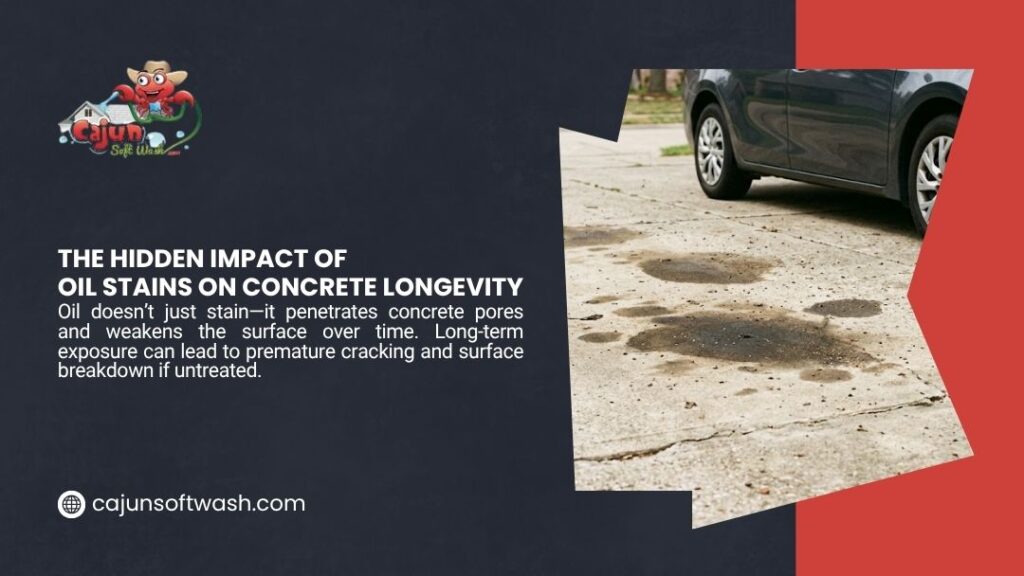
Stain type and severity: This is where quotes can vary by hundreds of dollars. Oil and grease stains don’t respond to water pressure alone; they need a degreaser pre-treatment and often multiple passes. Rust stains from metal furniture or iron-heavy well water require a completely different chemical approach. Algae and mildew need a biocidal solution that kills the growth, not just pressure that blasts the surface layer off. A crew that skips proper pre-treatment is giving you a cheaper quote and a shorter-lasting result.
How long has it been neglected? There’s a real price difference between a driveway that gets cleaned every year and one that hasn’t been touched in four. Accumulated organic growth builds up layers. Embedded oil soaks deeper over time. Stains that would take 20 minutes to treat when fresh can take an hour or more after years of sitting. If you’ve been putting off a cleaning, factor that into your expectations.
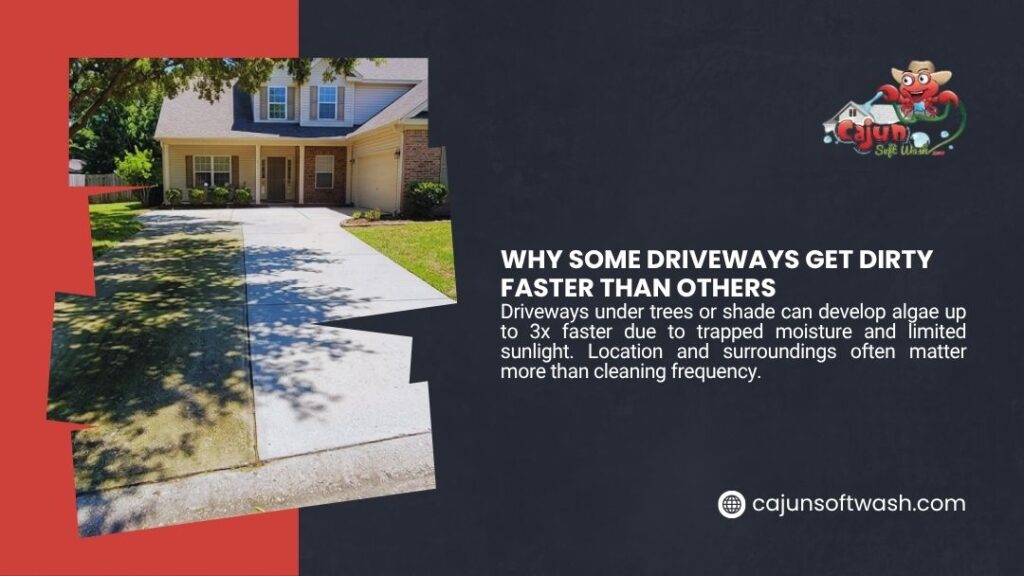
Local climate and humidity: In humid regions, such as South Louisiana, Louisiana humidity and exterior cleaning conditions make algae, mildew, and organic staining build up faster, grow thicker, and require more aggressive treatment. That’s just the environment. It doesn’t mean every job costs more, but it does mean that what looks like a light cleaning job from the street sometimes has significant biological growth that has to be addressed properly.
Accessibility and water supply. Easy access around the driveway perimeter, a functional outdoor spigot nearby, and clear space to maneuver equipment all contribute to lower labor time. If a crew has to haul water, work around parked vehicles, or navigate tight landscaping, the time goes up.
Add-ons and protective treatments. Sealing after a clean is the most common upgrade, and it’s genuinely worth considering. A sealed surface resists future staining, repels moisture, and is dramatically easier to clean next time. It roughly doubles the initial cost but can extend the interval between professional cleanings. Rust removal, efflorescence treatment, and deep degreasing are other add-ons that address specific problems and come with their own pricing.
Pressure Washing Prices vs. Power Washing Prices: The Difference Matters
These terms get used all the time interchangeably, including by contractors who should know better. They’re not the same thing, and the distinction affects both price and results.
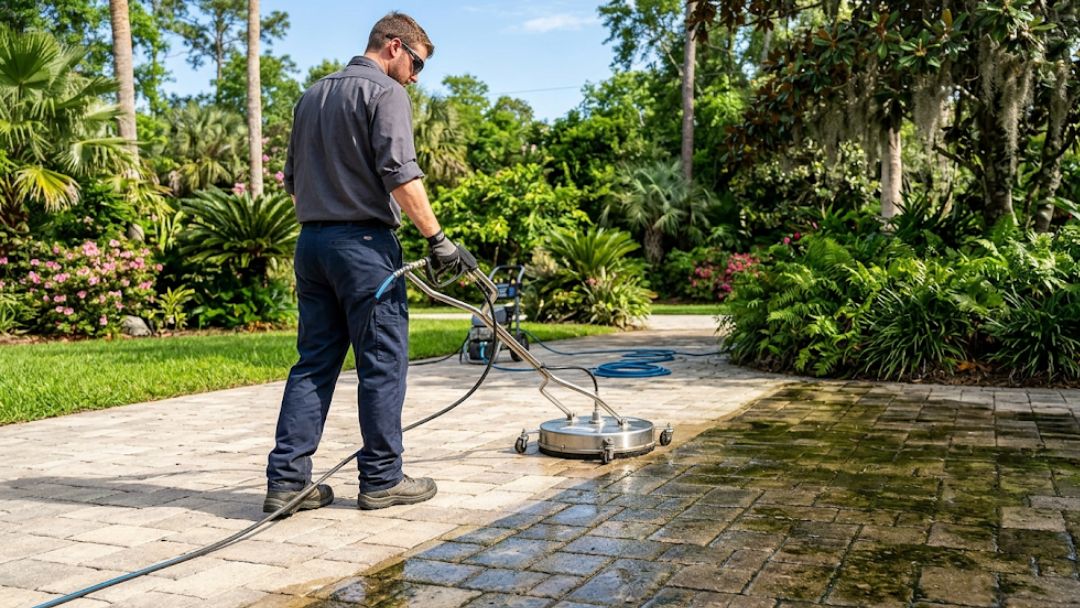
Pressure washing uses cold, high-force water. It’s effective for surface-level dirt, algae, and light staining. Most residential driveway cleaning falls into this category.
Power washing uses heated water, essentially a pressure washer with a heating element. The heat dramatically improves performance on grease, oil, and heavy organic buildup. It’s also harder on surfaces if the operator isn’t careful, and the equipment costs more, which shows up in the rate.
| Service Type | Average Cost | Best For |
| Pressure washing | Lower end | Surface dirt, light stains |
| Power washing | Higher end | Oil, grease, deep stains |
For a standard residential driveway with general soiling and maybe some algae, pressure washing is usually sufficient. For a driveway with years of oil drips from a vehicle, a parking pad near a garage where fluids accumulate, or heavy biological buildup, power washing or a combination approach with pre-treatment chemicals is the more honest recommendation.
How Much Does It Cost to Pressure Wash a Driveway vs. a House?
These are frequently quoted together because many homeowners consider both at the same time, and bundling is often the smarter financial move.
| Service | Average Cost |
| Driveway cleaning | $100 – $300 |
| House washing | $250 – $800 |
Driveway cleaning is typically the less expensive of the two. The reasons are fairly practical: there’s no height involved, no delicate siding to protect, fewer variables around surface materials, and the setup is simpler.
A two-person crew can move efficiently on open concrete in a way that’s not possible when working around window frames, trim, and landscaping on a home’s exterior.
That said, when you combine both services in a single appointment, you’re usually looking at a package discount. The crew is already on-site, the equipment is already set up, and the mobilization cost gets shared across both jobs. Ask about bundled pricing before booking separately.
DIY vs. Professional Driveway Cleaning Cost
The honest version of this comparison isn’t just about price, it’s about what you’re actually getting.
| Option | Cost | What to Expect |
| DIY pressure washer rental | $100 – $400 | Inconsistent results, risk of surface damage |
| Professional service | $150 – $800 | Uniform, longer-lasting clean |
Renting a consumer-grade pressure washer for a Saturday afternoon seems like a money-saver on the surface. And for light cleaning on a forgiving surface, it can work fine. The problems start when you’re dealing with anything more stubborn, oil stains, algae that’s been growing for a while, or a surface like pavers, where getting the pressure setting wrong causes real damage.
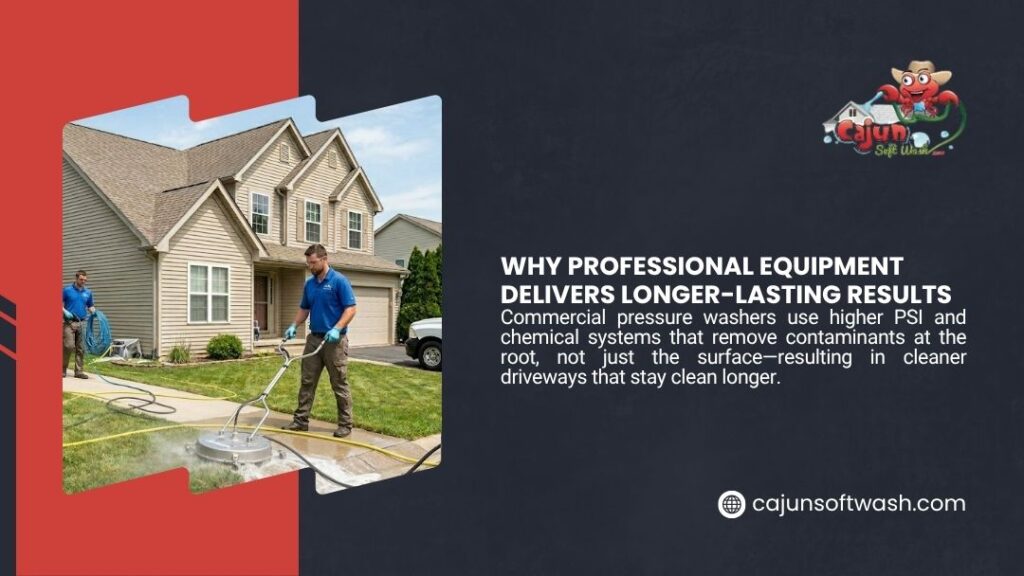
Consumer-grade washers typically max out at 1,500 to 2,000 PSI. Professional equipment runs 3,000 to 4,000 PSI and above, with adjustable nozzles and chemical injection systems that allow pre-treatment and rinse cycles in a single pass. The gap in results isn’t minor.
There’s also the damage risk factor. Concrete is forgiving within limits. Pavers, decorative stamped surfaces, or aging concrete with existing cracks are not. Wrong pressure, wrong angle, or moving too fast leaves streaking patterns or surface etching that’s difficult to reverse.
When those repairs cost more than the professional cleaning would have, and this happens regularly, the math on DIY stops making sense.
How Much Should You Charge for Pressure Washing a Driveway?
For contractors reading this, or homeowners trying to understand whether a quote is fair, here’s how professional pricing typically works.
Most experienced providers price residential driveways at $0.15 to $0.40 per square foot. Hourly rates exist, usually $50 to $150 per hour, but square footage pricing is more common because it ties compensation to the scope of work rather than how fast you move.
A legitimate pressure washing pricing structure factors in: chemical costs (which vary significantly depending on what treatments a job requires), equipment wear and maintenance, travel time, labor, and overhead. A quote that seems unusually low is usually cutting somewhere in that list, most often on chemical quality, dwell time, or both.Certifications matter here. A crew that has gone through professional training, like the certification program (such as those from ISSA/Cleaning Management Institute or IICRC), has learned proper chemical mixology, surface-specific techniques, and plant and property protection protocols. That training has a cost that gets reflected in pricing, and it’s a cost that protects the customer.
How Long Does It Take to Pressure Wash a Driveway?
A standard residential driveway takes one to three hours. That’s a wide window, and it comes down to size and condition.
A 400-square-foot concrete driveway with light soiling might be done in under an hour. A 700-square-foot surface with oil staining, a pre-treatment soak, and a sealing application could take four hours or more from start to finish. A commercial parking lot is a completely different scale, a 5,000+ square foot surface with heavy traffic staining is often a multi-crew, multi-hour job.
When a contractor is estimating your project, ask for a time estimate alongside the price. It tells you something about how thoroughly they plan to approach the job. A crew that says they’ll clean a heavily stained 600-square-foot driveway in 30 minutes is either working incredibly fast or skipping steps.
Real Pricing Examples
These aren’t hypotheticals; they reflect the range of real jobs and what drives the price.
| Scenario | Size | Condition | Estimated Cost |
| Small residential driveway | 400 sq ft | Light dirt | $100 – $150 |
| Medium driveway with stains | 600 sq ft | Oil + algae | $250 – $350 |
| Large driveway + sealing | 800 sq ft | Moderate + sealant | $500 – $700 |
| Commercial parking lot | 5,000+ sq ft | Heavy buildup | $1,500+ |
That jump from light-dirt residential to commercial heavy-buildup isn’t just about size; it’s about everything that has to happen before the surface is actually clean.
When Should You Actually Hire a Professional?
DIY makes sense for light maintenance on simple surfaces. It stops making sense fast in a few specific situations.
You’re dealing with oil or grease stains that have been sitting for months or years. You have pavers or decorative concrete that could be damaged by incorrect pressure. The driveway hasn’t been cleaned in several years and has layers of accumulated growth. You’re preparing a property for sale and need results that look professional. You’ve already tried DIY, and the results were streaky or incomplete.
Any of those situations points toward a professional service. Not because the work is beyond a motivated homeowner, but because the equipment, chemistry, and technique required to do it correctly sit outside what a rental unit and a weekend afternoon can deliver.
A proper concrete washing job, done right, with correct chemical pre-treatment and appropriate pressure, restores surfaces that genuinely look like replacements are needed. That’s a different category of result than what most consumer equipment produces.
How Often Should You Clean Your Driveway?
Once a year is the standard starting recommendation. For most homeowners with concrete driveways and moderate traffic, this keeps the surface looking maintained and prevents buildup from compounding.
In humid climates, twice a year is often more realistic. Algae and mildew don’t observe annual cleaning schedules; they grow continuously in warm, moist conditions. In Louisiana, particularly in the months following heavy rain seasons, organic growth can return to noticeable levels within a few months of a cleaning.
High-traffic properties, homes with multiple vehicles, commercial parking, or heavy foot traffic near the driveway surface, also benefit from more frequent attention. The grime builds faster, and the longer it sits, the harder (and more expensive) it is to remove.
Regular maintenance isn’t just about appearance. It prevents the deep staining and surface degradation that turns a cleaning job into a restoration job. The price difference between those two categories is significant.
Hidden Costs Most Homeowners Miss
Base pricing covers the basics. Here’s what often doesn’t make it into the initial quote.
Chemical pre-treatment for oil or organic stains is sometimes considered standard and sometimes an add-on. Clarify upfront. Travel fees apply in some markets, particularly for jobs outside a contractor’s primary service area. A company based in Gonzales coming out to a rural address 45 minutes away may price that differently than a local call.
Minimum charges catch homeowners off guard on small driveways. If a company has a $150 minimum, a 300-square-foot driveway at $0.20/sq ft would normally be $60, but you’re paying $150 anyway. That’s not unreasonable given mobilization costs, but it’s worth knowing before you get the invoice.
Re-treatment or warranty work, some companies offer guarantees on algae regrowth, and some don’t. If regrowth appears within 60 days of a cleaning, knowing whether your contractor covers that re-treatment saves a real conversation later.
Sealing is almost always quoted separately. If a contractor bundles it automatically without discussing it, that should prompt a question about what you’re actually being charged for.
How to Save Money on Driveway Cleaning Costs?
Bundle services: This is the clearest path to reducing per-service cost. Scheduling driveway cleaning alongside house washing, patio cleaning, or fence washing in a single visit shares the mobilization and setup costs across multiple jobs. Most reputable companies offer a meaningful discount for bundled work.
Book during off-peak periods: Spring is the busy season for exterior cleaning. Fall and winter bookings often come with better availability, sometimes better pricing, and a crew that isn’t rushing between jobs.
Maintain it between professional cleanings: A simple garden hose rinse after muddy weather, keeping vehicles that drip fluids off the driveway when possible, and addressing bird or tree droppings quickly. These small habits reduce the severity of buildup and keep your professional cleaning in the lower cost tier.
Get three quotes, not one: Pricing varies enough between providers that a single quote gives you no reference point. Three quotes from reputable local companies, not the lowest bidder from an anonymous app, give you a realistic picture of what your specific job should cost.
Ask about loyalty or referral rates: Many local exterior cleaning companies offer returning customer discounts or refer-a-neighbor programs. These aren’t always advertised, but they exist, and they add up over time.
FAQs About Driveway Cleaning Cost
What causes the black stains on my concrete driveway?
Those dark patches are usually Gloeocapsa magma, the same algae that causes black streaks on roofs. It thrives in humid, shaded conditions and feeds on the limestone in concrete surfaces. Pressure washing alone can remove the surface layer, but without a proper biocidal treatment, the root system remains, and growth returns faster than you’d expect. A proper cleaning addresses the biology, not just the appearance.
Can pressure washing damage my driveway?
Yes, if done incorrectly. Too much pressure on aging concrete can pit the surface or widen existing cracks. On stamped or decorative concrete, high pressure can strip the color finish. Pavers are particularly vulnerable; too much force dislodges the joint sand that holds them in place. This is one of the primary reasons professional service from a trained crew matters. Knowing what pressure, what nozzle angle, and what dwell time to use on each surface comes from experience, not guesswork.
How often should I have my driveway professionally cleaned in Louisiana?
Once a year at minimum, and twice a year is a reasonable approach for homeowners dealing with significant shade cover or algae recurrence. Louisiana’s heat and humidity create ideal growing conditions for mold, mildew, and algae. Waiting two or three years between cleanings, which might be reasonable in a drier climate, often results in heavy buildup that costs significantly more to treat than an annual maintenance clean.
What’s the difference between driveway cleaning and driveway sealing, and do I need both?
Cleaning removes dirt, stains, and biological growth from the surface. Sealing applies a protective coating after cleaning that fills surface pores, repels moisture and staining, and slows organic regrowth. They serve different purposes. Cleaning is maintenance.
Sealing is protection. You always need to clean before you seal; sealing over a dirty surface traps contaminants underneath and defeats the purpose. Whether you need both depends on how much you want to extend the time between future cleanings and how protected you want the surface.
Why does my driveway look clean right after washing, but turn dark again within a few months?
This is almost always a sign that the organic growth, algae, mold, or mildew wasn’t fully eliminated during the cleaning. High pressure removes what’s visible on the surface, but if the root system wasn’t treated with a proper biocidal solution, regrowth happens from below.
It can also happen if the cleaning removes staining but leaves behind surface conditions that accelerate new growth. Ask your contractor specifically whether their process includes chemical treatment that kills growth at the root, or whether they’re relying on pressure alone.
Does a clean driveway actually affect my home’s resale value?
More than most people expect. Curb appeal is one of the first things prospective buyers and appraisers assess. A driveway stained with oil, covered in algae, or showing visible neglect signals deferred maintenance to anyone walking toward your front door.
A clean, well-maintained driveway, especially paired with a clean exterior and roof, communicates that a property has been cared for. That perception translates into offers and appraisal outcomes in ways that are disproportionate to the cost of the cleaning itself.
What This Means for Your Property Value
A clean driveway does more work than it gets credit for. It’s not just about aesthetics, though those matter, especially when neighbors, guests, or potential buyers are forming impressions before they reach your front door.
Concrete and paver surfaces that accumulate biological growth and staining over time aren’t just unsightly. They’re degrading. Algae roots work into surface pores. Oil penetrates and weakens concrete over the years.
Accumulated moisture from biological buildup accelerates freeze-thaw cracking in regions that see temperature swings. Regular cleaning removes the agents of that deterioration before they do lasting damage.
For homeowners maintaining properties with long-term resale in mind, a consistent exterior cleaning schedule, driveway included, is part of the same logic as keeping up with roof maintenance, HVAC service, and foundation checks. It’s not a luxury. It’s how you protect what you’ve already invested.
Final Thoughts: What Should You Do Next?
Look at your driveway this week, actually look at it. Not a glance from the car on your way out in the morning. Walk out and look at the surface in daylight. Check the edges where organic growth typically starts. Look at the area where vehicles are regularly parked. Check for the early stages of that dark discoloration, which looks subtle now but becomes obvious in about six months.
If what you see tells you it’s time, getting a professional assessment costs nothing. A reputable local crew will tell you honestly what the job involves, what treatment it needs, and what it should cost, without surprises at the end.
Driveway cleaning cost isn’t something to overthink. But it is something to understand before you commit to a quote. The right service uses the right method for your surface, treats the actual cause of staining, and leaves you with results that last longer than a season. That’s where residential cleaning services like Cajun Softwash actually know what they’re doing, and make a difference. And it’s why the cheapest quote isn’t always the one worth taking.